
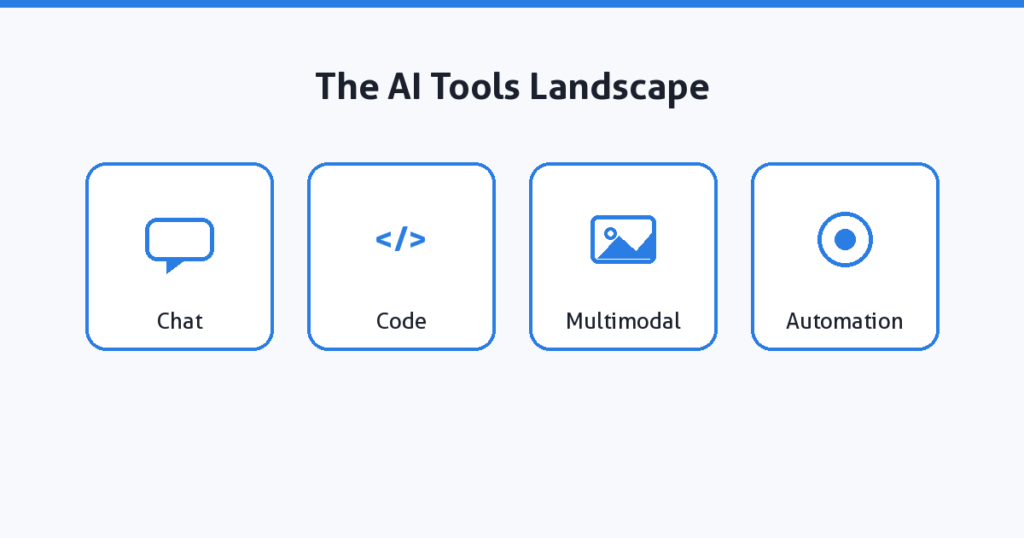
Every week brings a new “must-have” AI app. Most are noise. A handful, though, have become genuinely embedded in how companies operate — the ones your competitors are already quietly using to move faster and spend less on the work that used to eat entire teams. Here’s what’s actually commercially significant right now, and why it matters even if you’re not a developer.
The Big Four General-Purpose Assistants
Four platforms dominate day-to-day business use of AI: OpenAI’s ChatGPT, Anthropic’s Claude, Google’s Gemini, and Microsoft’s Copilot. They overlap heavily, but each has carved out a different reputation:
- ChatGPT is the default all-rounder — the one most people mean when they say “AI.” Its reach across Global 2000 companies as a production tool is hard to overstate.
- Claude has built its reputation on coding and longer, more autonomous work — the kind of task where you hand over a problem and expect a finished result, not just a suggestion.
- Gemini leads on cost-efficient, high-volume, multimodal work — think processing thousands of images, documents, or video frames without the bill spiraling.
- Copilot wins on distribution, not headlines — it’s baked directly into Microsoft 365, which puts it in front of hundreds of millions of people who never had to “choose” an AI tool at all.
The practical takeaway: the “best” AI tool question is the wrong one. The companies getting real value aren’t betting on a single model — they’re running more than one, matched to the job, because each genuinely wins at different tasks.
The Tool That Actually Makes AI Useful at Work: Automation Platforms
Here’s what most “top AI tools” lists miss: a chat window is not a business process. The real commercial unlock happens when an AI model is wired into your actual systems — your CRM, your inbox, your spreadsheets, your support tickets — so it can act, not just answer questions.
That’s the job of workflow automation platforms, and the one gaining the most traction with technical teams right now is n8n. It’s open-source, self-hostable, and built specifically to connect AI models to hundreds of real-world apps and APIs — turning “the AI said I should follow up with this customer” into “the AI actually did it.” We cover exactly how it works in our companion article on how workflow automation platforms like n8n are built.
The Quiet Cost Problem Nobody Talks About
There’s one more piece that decides whether any of this is actually affordable at scale: how much you’re paying per API call. As usage grows from “a few team members experimenting” to “AI running inside a real workflow,” the bill can grow just as fast — unless you’re using caching, a technique that can cut costs by 50–90% without touching output quality. We break that down in our guide to AI caching.
The Bottom Line
The commercially significant AI stack in 2026 isn’t one app — it’s three layers working together: a model (or several) for the thinking, an automation platform like n8n for the doing, and caching for keeping the whole thing affordable as it scales. Get familiar with all three, and you’re ahead of most of the market.